Showing posts with label Opposite. Show all posts
Showing posts with label Opposite. Show all posts
Friday, March 24, 2017
The Opposite Winter
Lost in thought, the tip of my birch paddle reminds me of the gravel and shell infused sandbar that sweeps my way off of Pond Point.
I set out from the beach on a falling tide that limits my choices of where to go, but, in this prolonged cold, my choices have already been reduced, the fresh water and protected places of the salt marshes frozen over, at least well enough to keep my canoe out. The sky is high thin clouds that signal a possibility of snow, but the wind is light and the air about 20F.
 |
| Charles Island |
This winter has been the opposite of the last, at least in relation to the freezing point of water. Last winter, the weather was above freezing with only short spurts of icier cold. This winter has been a long stretch of subfreezing weather that has locked up the fresh water streams. Just a day or two at a time of warmer weather comes, tempting the ice to break up, but not completing the task.
32F (or 0C) is everything. Water, snow and ice have dozens of different properties to take on within a couple degrees of that number. Most people don't quite get it, except to how it affects their commutes, but people of the outdoors see it first hand. The nordic skiers have one or two ski wakes for 10 to 20 degrees, another one or two for 20 to 28 degrees, and about a dozen for 30 to 34 degrees, when the snow is part water, part snow, and part ice in varying degrees. From my canoe, I notice the birds. This winter, a great many more birds are in the salt water. Ducks and geese that prefer fresh water or brackish salt marshes are doing their feeding in the shallows of the sea. The population and density is up as they too, have limited choices of where to go.
 |
| Milford Harbor |

Thursday, March 9, 2017
Opposite Ends of India
More photos of Indian boats from reader Paul Wilson, who kindly provided photos for earlier posts on boats in Goa, Philippine bancas, and Myanmar longtails.
The first batch was taken in Varanasi (also known as Benares) in the northern state of Uttar Pradesh, in 2004. Here's Paul's brief description, followed by my captions:
Paul took the next set of photos in 2004 in Rameswaram, a town on Pamban Island, in the southern state of Tamil Nadu at the opposite end of the Indian subcontinent and close to Sri Lanka.
The first batch was taken in Varanasi (also known as Benares) in the northern state of Uttar Pradesh, in 2004. Here's Paul's brief description, followed by my captions:
(Varanasi is a) sacred pilgrim city along the banks of the Ganges. On the other side of India from Kerala but very similar boats to the ones in Kerala. [We'll look at the Kerala photos in a future post; Ed.] I included these pictures to show that the construction of the boats is also edge sewn planking. I think it is interesting to see how they add the frames after the planks are sewn together. It surprises me how poorly supported the planking is in the photo. The color you see in the water is flower petals from the burials and the pilgrims religious offerings. In the pictures you can also see the high water marks when the river goes to flood.
 |
| Although these boats resemble Western craft superficially, their shell-first, smooth-skinned construction makes them quite different in fact. (Click any image to enlarge.) |
 |
| There seem to be both double-ended and transom-stern boats here. No hint in the photo about how these boats are used. |
 |
| The hull planking is complete. The frames have been cut but are yet to be installed, and the width of the hull is set by temporary bamboo stretchers.. Note how the frames don't quite match the curve of the hull. As the components are fastened to one another, they will both deform somewhat, but I'd bet that the hull will conform more to the shape of the frames than vice versa. |
 |
| A very nice leaf-shaped hull. The frames don't extend into the bottom: they only support the planking between the turn of the bilge and the gunwales. The deck beams, however, are hefty. The framework that's being used to dry clothes might also be used to support very lightweight walls and a roof, or might serve to display goods for sale. |
 |
| The fourth boat from the top is considerably longer but no wider than the others, and narrower than some of them. She looks fast and graceful. |
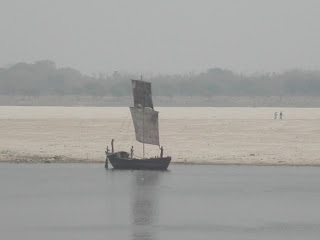 |
| Fascinating rig: a tall single mast carrying square mainsail and topsail, and steered with a side rudder. (Let's not speculate about cultural transmission with Medieval Europe.) |
 |
| Coastal fishing scene. The boats here are deeper than the river craft shown in the Varanasi photos. |
 |
| These hulls have quite a lot of rocker. Although the water is dead calm in this shot, they are probably meant to maneuver in surf. |
 |
| With full floor timbers and much more heavily framed than the Varanasi boats, this boat could easily be mistaken for a Western design. |
 |
| Profile shot of the same boat. |
 |
| The lateen rig on a steeply canted mast and a stern rudder provide significant contrast to the Varanasi sailboat shown earlier. |
Subscribe to:
Posts (Atom)